The 2026 TFSA Update: Your $109,000 Tax-Free Opportunity
Happy New Year, 2026! 🇨🇦 If there is one resolution every Canadian investor should stick to this year, it’s maximizing their Tax-Free Savings Account (TFSA).
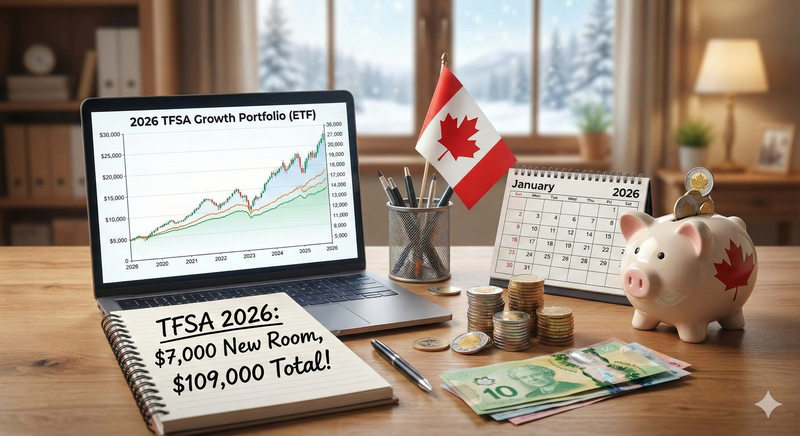
As of January 1st, we have officially unlocked another $7,000 in contribution room. Whether you are a total beginner just opening your first account or a seasoned investor looking to optimize your portfolio, this update is for you.
For those who have been eligible since the program started in 2009, the total lifetime contribution room has now reached a massive $109,000. That is over six figures of capital that can grow completely tax-free—forever.
In this post, we’ll break down the 2026 numbers, clear up the confusion around CRA contribution limits, and look at just how powerful this account can be with a little compound interest.
2026 TFSA Contribution Limit & Historical Breakdown
If you have lost track of your contribution room over the years, you aren't alone. The annual limit changes based on inflation, which can make it tricky to keep up.
Here is the definitive breakdown of TFSA contribution limits since the program's inception. If you have never contributed, were at least 18 years old in 2009, and have been a resident, the total sum below is your available room.
Quick Tip: Not sure what your personal limit is? Use our free TFSA Contribution Room Calculator to get an accurate amount based on your age, total contributions, and total withdrawals.
| Year | Annual Limit | Cumulative Total |
|---|---|---|
| 2009 | $5,000 | $5,000 |
| 2010 | $5,000 | $10,000 |
| 2011 | $5,000 | $15,000 |
| 2012 | $5,000 | $20,000 |
| 2013 | $5,500 | $25,500 |
| 2014 | $5,500 | $31,000 |
| 2015 | $10,000 | $41,000 |
| 2016 | $5,500 | $46,500 |
| 2017 | $5,500 | $52,000 |
| 2018 | $5,500 | $57,500 |
| 2019 | $6,000 | $63,500 |
| 2020 | $6,000 | $69,500 |
| 2021 | $6,000 | $75,500 |
| 2022 | $6,000 | $81,500 |
| 2023 | $6,500 | $88,000 |
| 2024 | $7,000 | $95,000 |
| 2025 | $7,000 | $102,000 |
| 2026 | $7,000 | $109,000 |
Warning: Don't Trust "My Account" Blindly
Every January, thousands of Canadians log into their CRA "My Account" to check their contribution room, see a number, and blindly contribute that exact amount. This is a dangerous mistake.
The number you see on the CRA website is not real-time. Despite it saying "As of January 1st, 2026, it is NOT accurate.
Financial institutions (banks, brokerages) only report your contributions and withdrawals to the CRA once a year, typically in late February or March. This means:
- Many of your 2025 withdrawals or contributions aren't taken into account by the CRA yet.
- If you rely solely on their number, you might accidentally over-contribute.
The penalty for over-contribution is 1% per month on the excess amount. It’s nasty, and it’s easily avoidable. Always keep your own records of what you put in and what you took out.
The "Golden Rule" of Withdrawals
One of the most misunderstood aspects of the TFSA is what happens when you take money out.
The Rule: Whatever amount you withdraw is added back to your contribution room on January 1st of the following year.
Example:
- It is July 2026. You have maxed out your TFSA.
- You withdraw $10,000 to pay for a renovation.
- Result: You cannot put that $10,000 back in during 2026 (unless you have unused room from previous years).
- Wait: On January 1, 2027, your new limit will be the annual limit (likely $7,500) PLUS the $10,000 you withdrew.
This flexibility makes the TFSA an incredible tool for short-term goals (like a wedding or house down payment) and long-term wealth building.
Strategy: What Should You Hold in a TFSA?
Because you don't pay taxes on the growth inside a TFSA, you want to prioritize investments that have the highest potential for growth. This is only the case if your TFSA is maxed. If it is not maxed out, the TFSA is an ideal spot for any investment, including short term savings in GIC/bonds.
- Best for TFSA: Equity ETFs (like XEQT, VEQT, or VFV). These have high expected returns over the long run. Shielding these large gains from the taxman is the ultimate win.
- Less Ideal for TFSA: Cash, GICs, or Bonds (unless you are saving for a short-term goal). These generate lower returns, so the "tax savings" are less significant compared to high-growth equities.
If you are young or have a long time horizon, filling your TFSA with low-cost, high-growth ETFs is generally the most efficient strategy.
The Power of Compounding: What Could a Maxed TFSA Be Worth?
A lot of people still treat the TFSA like a standard savings account (holding cash earning 1% or 2%), but its true power is unlocked when you use it for investing.
Let's run a hypothetical scenario.
Imagine you had maxed out your TFSA every single January since 2009. Instead of leaving it in cash, you invested it in a globally diversified 100% equity ETF (like the popular XEQT, or a similar proxy for global markets) which we'll assume returned an average of 9% annually.
- Total Cash Contributed (Principal): $109,000
- Estimated Investment Value in 2026: ~$240,000
By simply contributing the limit and letting the market do the work, your tax-free pot could be worth more than double what you put in. And the best part? If you withdrew that entire $200k+ balance today, you would pay $0 in taxes.
(Note: XEQT was launched in 2019, but the underlying index funds track markets that have historically provided strong long-term returns. Past performance doesn't guarantee future results, but it illustrates the potential of long-term ETF investing.)
| Year | Annual Contribution | Start Balance | End of Year Value (Assumes 9% Return) |
|---|---|---|---|
| 2009 | $5,000 | $5,000.00 | $5,450.00 |
| 2010 | $5,000 | $10,450.00 | $11,390.50 |
| 2011 | $5,000 | $16,390.50 | $17,865.65 |
| 2012 | $5,000 | $22,865.65 | $24,923.55 |
| 2013 | $5,500 | $30,423.55 | $33,161.67 |
| 2014 | $5,500 | $38,661.67 | $42,141.22 |
| 2015 | $10,000 | $52,141.22 | $56,833.93 |
| 2016 | $5,500 | $62,333.93 | $67,943.99 |
| 2017 | $5,500 | $73,443.99 | $80,053.95 |
| 2018 | $5,500 | $85,553.95 | $93,253.80 |
| 2019 | $6,000 | $99,253.80 | $108,186.64 |
| 2020 | $6,000 | $114,186.64 | $124,463.44 |
| 2021 | $6,000 | $130,463.44 | $142,205.15 |
| 2022 | $6,000 | $148,205.15 | $161,543.61 |
| 2023 | $6,500 | $168,043.61 | $183,167.54 |
| 2024 | $7,000 | $190,167.54 | $207,282.62 |
| 2025 | $7,000 | $214,282.62 | $233,568.05 |
| 2026 (Jan) | $7,000 | $240,568.05 | -- |
| *Hypothetical scenario assumes a consistent 9% annual return, with contributions made on January 1st of each year. | |||
Conclusion
The 2026 TFSA limit of $7,000 is another step toward financial freedom for Canadians. With a total lifetime room of $109,000, this account is no longer just a "savings" jar—it's a serious wealth-building machine.
Your Action Plan:
- Log into your brokerage account.
- Check your personal records (not just the CRA website) to confirm your room.
- Transfer funds and invest in a low-cost, diversified ETF.
- Let the compounding snowball continue to grow.
Stay Updated
Get the latest investment insights delivered to your inbox. We will not spam you with emails. Emails will be limited to around one per month, and may contain relevant market updates, new features, or new blog posts.
Image Gallery
More Articles
Market Analysis
Stay informed with our latest market insights and analysis.