Avantis CIBC ETFs: Complete Guide to Canada's New Factor-Tilted ETFs (2026)
Avantis Investors — the firm founded by former Dimensional Fund Advisors (DFA) executives — has officially landed in Canada.
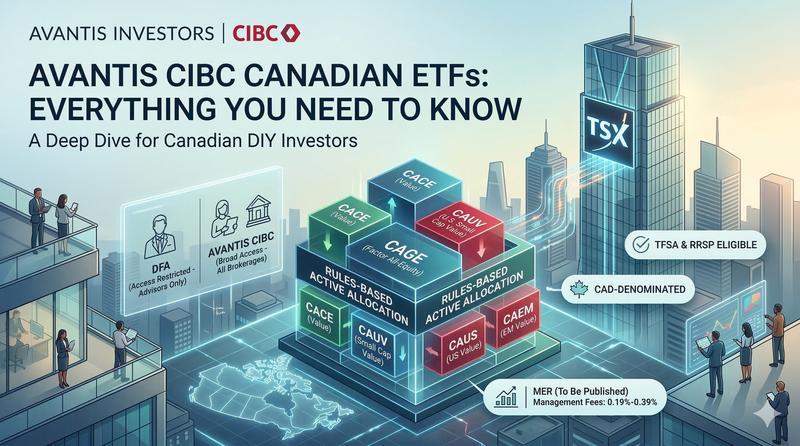
Through a strategic partnership with CIBC Asset Management, eight new Avantis CIBC ETFs will soon be trading on the Toronto Stock Exchange.
For Canadian investors who have watched the factor investing conversation from the sidelines — unable to access Avantis products without a USD brokerage account (and the associated costs) — this is a significant development. Let's break down what these ETFs are, what factor tilting actually means, and whether any of this belongs in your portfolio.
All 8 Avantis CIBC ETFs: Tickers, Fees, and What They Do
Here's the full lineup of eight ETFs launched through the CIBC and Avantis partnership:
| Ticker | Fund Name | Mgmt Fee | Focus |
|---|---|---|---|
| CACE | Avantis CIBC Canadian Equity ETF | 0.19% | Broad Canadian equities with value/profitability tilt |
| CAUS | Avantis CIBC U.S. All-Cap Equity ETF | 0.19% | Broad U.S. equities with value/profitability tilt |
| CALV | Avantis CIBC U.S. Large Cap Value ETF | 0.25% | U.S. large cap stocks with deeper value tilt |
| CAUV | Avantis CIBC U.S. Small Cap Value ETF | 0.35% | U.S. small cap stocks with value/profitability tilt |
| CADE | Avantis CIBC International Equity ETF | 0.29% | International developed equities with factor tilt |
| CASV | Avantis CIBC Global Small Cap Value ETF | 0.39% | Global small cap value stocks |
| CAEM | Avantis CIBC Emerging Markets Equity ETF | 0.39% | Emerging market equities with factor tilt |
| CAGE | Avantis CIBC All-Equity Asset Allocation ETF | 0.28% | All-in-one global equity portfolio with factor tilts |
The first four (CACE, CAUS, CALV, CAUV) began trading on February 20, 2026. CADE and CASV started trading on March 13, 2026, and CAGE begins trading on March 18, 2026. It has not yet been announced when CAEM will begin trading, as they are still working on getting approvals in different countries. All new Avantis ETFs will have quarterly distributions.
Because these ETFs are brand new, Canadian regulations prevent them from displaying performance data or MERs in their first year, but Caitlin Ebanks, the Director of ETF Strategy at CIBC, stated they expect the MER to be the management fee + taxes. CIBC will cover other operational expenses. That means for CAGE, we can expect a MER around 0.32%.
Although we can't compare performance data on the new ETFs yet, the underlying strategies mirror the well-established Avantis ETFs that have been trading in the U.S. since 2019 — and those have a meaningful track record.
Who Is Avantis Investors?
If you follow evidence-based investing, you've probably heard of Dimensional Fund Advisors (DFA). DFA built its reputation on designing funds rooted in academic factor research — primarily the work of Nobel laureate Eugene Fama and Kenneth French. For decades, DFA funds were only available through approved financial advisors, making them inaccessible to most DIY investors in Canada.
Avantis Investors was founded in 2019 by former DFA executives, including Chief Investment Officer Eduardo Repetto, who previously served as DFA's CIO. The key difference? Avantis products are available as ETFs that anyone can buy on the open market. Since launch, Avantis has grown rapidly, surpassing $125 billion in assets under management as of February 2026.
Avantis sits in an interesting space — the funds are technically classified as actively managed, but the approach is highly systematic. They don't have a stock-picking team making gut calls. Instead, they use a rules-based process rooted in academic research to overweight stocks trading at lower valuations with higher profitability. Think of it as "structured indexing" rather than traditional active management.
What Is a Factor Tilt?
If you're investing in a total market index fund like XEQT or VEQT, you're holding stocks weighted by their market capitalization. Apple is big, so you hold a lot of Apple. A tiny mining company is small, so you hold almost none of it. You get the return of the overall market — nothing more, nothing less.
A factor tilt is a deliberate decision to overweight certain types of stocks that academic research has identified as having higher expected returns over long time periods. The key word there is "expected" — there's no guarantee, and these premiums can disappear for years or even decades at a time.
The factors that Avantis primarily targets are value and profitability:
Value means tilting toward companies whose stock price is low relative to their fundamental measures like book value, earnings, or cash flow. You're buying more of the "cheap" stocks and less of the "expensive" ones.
Profitability means tilting toward companies that generate higher operating profits relative to their assets. This factor was formalized in Fama and French's five-factor model and helps screen out the kind of cheap stocks that are cheap for good reason (sometimes called "value traps").
Some of the Avantis ETFs — particularly CAUV and CASV — also tilt toward smaller companies (the size factor), targeting the intersection of small cap, value, and profitability that research suggests has historically offered the highest expected returns.
Why Would You Want a Factor Tilt? The Research
This is where the rubber meets the road. Why would you bother deviating from a simple, low-cost total market index fund? The answer comes down to decades of academic research — but that research comes with important caveats.
The Historical Evidence for Factor Premiums
The academic case for factor premiums goes back nearly a century. Using data from the Kenneth French Data Library, which tracks U.S. stock returns since 1926, the evidence is striking:
The Value Premium (HML — High Minus Low): Historically, U.S. value stocks have outperformed growth stocks by approximately 3-4% per year. In their landmark international study, Fama and French found that from 1975 to 1995, the annual return difference between global high and low book-to-market portfolios was 7.60%, with value outperforming growth in 12 of 13 major markets studied. This wasn't a U.S.-only phenomenon — it showed up virtually everywhere researchers looked.
The Size Premium (SMB — Small Minus Big): Small-cap stocks have historically outperformed large-cap stocks by approximately 2% per year in U.S. data since 1926, though this premium has shown considerable variation across different time periods and has weakened since its original publication.
The Profitability Premium (RMW — Robust Minus Weak): Companies with higher operating profitability have historically earned higher returns than those with lower profitability. Among the Fama-French factors, the profitability premium has been one of the most consistent across decades — it has never delivered a negative return over any full decade from the 1960s through the 2020s.
The Interaction Effect: The research suggests that these factors work best in combination. Small-cap value stocks with strong profitability have historically been the sweet spot. This is precisely the area that ETFs like CAUV and CASV target — they don't just buy small or cheap stocks; they layer in a profitability screen to avoid the weakest companies.
Why Do Factor Premiums Exist?
This is actually one of the most important questions you can ask. If these premiums are well-documented and widely known, why haven't they been arbitraged away? There are two main schools of thought:
The Risk-Based Explanation: Value stocks and small-cap stocks are genuinely riskier in ways that aren't fully captured by market beta alone. Value companies tend to be more economically sensitive, more leveraged, and more vulnerable during recessions. Small companies face greater financing constraints and business risk. Investors demand a higher expected return for holding these riskier stocks — just as you'd demand a higher interest rate on a riskier loan. Under this view, the premium is compensation for real risk, and you should only pursue it if you have the ability and willingness to ride out the inevitable rough patches.
The Behavioral Explanation: Investors systematically overpay for exciting growth stories and glamorous large-cap stocks, while underpricing boring, out-of-favour value stocks. Humans are prone to extrapolating recent trends too far into the future, leading growth stocks to become overvalued and value stocks to become undervalued. Under this view, the premium represents a persistent pricing error driven by human psychology.
The truth is probably some combination of both. What matters for investors is that both explanations suggest the premiums can persist going forward — either because risk will always exist, or because human nature doesn't change.
The Evidence Is Global
One of the strongest arguments for factor premiums is their pervasiveness across different markets and time periods. This isn't just a quirk of U.S. data. A comprehensive study on momentum published in late 2025 found strong and consistent returns to momentum strategies across 46 countries and more than 150 years of data. The value premium has been documented in essentially every major stock market around the world.
More recently, the international evidence has been particularly compelling. Dimensional Fund Advisors' international factor funds have delivered notable results since 1996, with their International Small Value fund returning approximately 7.95% annually, compared to 5.45% for the broad MSCI EAFE Index. In the first half of 2025, international value stocks outperformed the S&P 500 by more than 18 percentage points — a powerful reminder that factor premiums can show up in dramatic fashion when market conditions shift.
The Counterarguments (And They're Real)
Intellectual honesty demands that we address the other side of this coin, because the critics aren't wrong about everything:
The recent U.S. track record is ugly. The 20-year relative return of U.S. small-cap value stocks versus the S&P 500 recently dipped negative for the first time in market history. That's two full decades where you would have been better off in a plain index fund. For most people's investing horizons, that is a significant chunk of their entire career.
Factor timing is nearly impossible. Factors are cyclical. Value can underperform for 10+ years (as it did from roughly 2010 to 2020 in the U.S.), and most academic research suggests that investors need an extremely long time horizon — often 15 years or more — to have reasonable confidence in capturing a factor premium. Many investors simply don't have the patience or stomach for this.
Crowding concerns. As factor investing has gone mainstream through smart-beta ETFs, global assets deployed in factor-based strategies have grown from roughly $4 trillion to over $6 trillion in the past decade. Some researchers worry that increased capital chasing these premiums could diminish them going forward.
Data mining worries. Of the hundreds of "factors" identified in the academic literature, most are likely statistical noise. Larry Swedroe and Andrew Berkin, in their book Your Complete Guide to Factor-Based Investing, concluded that only five factors met rigorous criteria: persistent across long periods, pervasive across markets, robust to different definitions, investable, and supported by economic theory.
Implementation costs matter. Academic factor returns are calculated on paper — they don't account for trading costs, management fees, bid-ask spreads, or tax consequences. The premium you actually capture in your portfolio will always be less than what the backtests show.
How Avantis Approaches Factor Investing
What makes Avantis interesting compared to traditional index-based factor ETFs is their implementation approach. Rather than rigidly tracking a factor index — which can lead to unnecessary turnover and trading at predictable times — Avantis uses a flexible, systematic process.
Each fund starts with a broad universe of stocks in its target market. The portfolio managers then evaluate every stock's current market price relative to a set of financial fundamentals: book value, earnings, cash flow, and profitability ratios. Stocks that score well on both value and profitability characteristics receive a higher weighting. Stocks that score poorly receive a lower weighting — but they're not necessarily excluded entirely.
This approach has a few practical advantages. It keeps trading costs low because the portfolio adjusts gradually rather than making big, sudden changes at index rebalancing dates. It maintains broad diversification, which reduces the risk of concentrating too heavily in any single sector or stock. And by combining value and profitability together, it aims to avoid the classic "value trap" problem of owning cheap stocks that are cheap because the underlying business is deteriorating.
Eduardo Repetto - CIO of Avantis - also clarified that CAGE's non-Canadian geographical weights will float, not be fixed. This will minimize turnover, and unnecessary costs.
CAGE vs. XEQT vs. VEQT: How Does Avantis's All-in-One Compare?
This is probably the question most Canadian investors are asking right now. If you're already using XEQT or VEQT as your all-in-one equity solution, should you switch to CAGE?
Here's how they stack up:
| Feature | CAGE | XEQT | VEQT |
|---|---|---|---|
| Management Fee | 0.28% | 0.17% | 0.17% |
| MER | TBD (Year 1) (~0.32% Expected) | 0.20%* | 0.24%* |
| Style | Factor-tilted (value + profitability) | Market-cap weighted | Market-cap weighted |
| Approach | Systematic active | Passive index | Passive index |
| Canadian Equity | ~30% | ~25% | ~31% |
| U.S. Equity | ~45% | ~45% | ~43% |
| International + EM | ~25% | ~30% | ~26% |
| Holdings | TBD | ~8,900 stocks | ~13,800 stocks |
| Inception | March 2026 | August 2019 | January 2019 |
Note: Vanguard cut VEQT's management fee to 0.17% in November 2025. The MER will update at the next fiscal year-end and is expected to come down to roughly 0.20%. BlackRock followed suite and cut XEQT's management fee to 0.17% in December 2025, dropping the MER to ~0.19%
The key differences come down to philosophy, not geography. XEQT and VEQT give you the market return at rock-bottom cost. CAGE gives you the market return plus a factor tilt at a slightly higher cost. You're paying a premium for the bet that value and profitability factors will deliver excess returns over time. Eduardo Repetto stated expected long-term outperformance should be around 1.5-2%, with a 3-4% tracking error, relative to a geographical matched market-cap weighted portfolio. It is critical to note that is the expected long-term premium, and there will be many years where the realized premium is negative.
If you're happy with XEQT or VEQT, there is no urgent reason to switch. CAGE is brand new with no Canadian track record, its full allocation details aren't public yet, and the cost difference — while small — compounds over decades. The factor tilt may or may not compensate for the higher fees.
CAGE might make sense if you believe in the academic factor evidence, you have a very long time horizon, and you want the simplicity of a single-ticker solution with built-in factor exposure. It's a cleaner alternative to building a multi-ETF Avantis portfolio yourself.
CAUS vs. VFV vs. XUU: Avantis's U.S. Equity ETF Compared
For investors who build their own multi-ETF portfolios, the more practical question might be whether CAUS replaces your existing U.S. equity holding.
| Feature | CAUS | VFV | XUU |
|---|---|---|---|
| Management Fee | 0.19% | 0.08% | 0.07% |
| MER | TBD (Year 1) | 0.09% | 0.07% |
| Style | Factor-tilted (value + profitability) | S&P 500 index | Total U.S. market index |
| Cap Range | All-cap | Large cap (S&P 500) | All-cap |
| Approach | Systematic active | Passive | Passive |
Who Are These ETFs For?
Let me be direct: if you're happy with a simple all-in-one ETF like XEQT or VEQT, there's absolutely nothing wrong with staying the course. A globally diversified, market-cap-weighted portfolio at ultra-low cost is a perfectly sound investment strategy. It captures the market return, it's simple, and it works.
The Avantis CIBC ETFs might be worth considering if:
You understand and accept tracking error. Factor-tilted portfolios will look different from the overall market — sometimes better, sometimes worse, sometimes dramatically worse for extended periods. You need to be prepared to stick with the strategy when it's underperforming, which is exactly when it's hardest to do so.
You have a long time horizon. The academic evidence suggests you need 15+ years to have reasonable confidence in capturing factor premiums. If you're investing for retirement that's decades away, the math may work in your favour. If you're 5 years from retirement, a factor tilt adds volatility you probably don't need.
You want a Canadian-listed alternative to U.S. Avantis ETFs. Previously, Canadian investors who wanted Avantis exposure had to buy the U.S.-listed versions (like AVUV, AVLV, or AVUS) through a U.S. dollar brokerage account. The new CIBC-listed versions trade in Canadian dollars on the TSX, simplifying the process considerably — though you'll want to compare the total cost once MERs are published.
You're building a multi-ETF portfolio and want to tilt specific allocations. For example, you might use CAUS as your U.S. equity allocation instead of a plain S&P 500 or total market fund. Or you might add CAUV as a satellite position alongside a core index holding.
My Take
The launch of these ETFs is genuinely exciting for the Canadian investing landscape. For years, evidence-based factor investing was essentially locked behind DFA's advisor-only model. Then Avantis came along and opened it up through U.S.-listed ETFs. Now it's available directly on the TSX, in Canadian dollars, through a major Canadian institution.
That said, I want to be balanced about this. The core message of this site has always been that simple, low-cost, globally diversified index investing works. It has worked, it continues to work, and it will likely continue to work going forward. You do not need factor tilts to build wealth.
Factor tilting is a bet that the historical premiums documented in nearly a century of academic research will persist into the future. It's a bet backed by solid evidence and sound economic theory. But it's still a bet — and it comes with real costs in the form of higher fees, portfolio complexity, tracking error, and the psychological challenge of sticking with a strategy during the inevitable periods when it underperforms. Factor tilting can underperform for a long time.
If you decide factor tilting is right for you, the Avantis CIBC ETFs are a strong way to implement it. The fees are reasonable, the investment process is well-designed, and the team behind the funds has deep experience in this space. Just go in with your eyes open about what you're signing up for.
This article is for educational purposes only and is not financial advice. Always do your own research before making investment decisions.
Frequently Asked Questions About the Avantis CIBC ETFs
Where can I buy Avantis CIBC ETFs in Canada?
All Avantis CIBC ETFs trade on the Toronto Stock Exchange (TSX) and can be purchased through any Canadian brokerage, including Wealthsimple, Questrade, Investor's Edge, and the major bank brokerages. They trade in Canadian dollars just like any other TSX-listed ETF.
Are Avantis CIBC ETFs eligible for TFSA and RRSP?
Yes. All eight Avantis CIBC ETFs are eligible for registered accounts including TFSAs, RRSPs, RRIFs, and RESPs.
What is the MER of the Avantis CIBC ETFs?
Because these ETFs launched in 2026, Canadian regulations prevent them from publishing an official MER until their first fiscal year-end. Management fees range from 0.19% (CACE, CAUS) to 0.39% (CASV, CAEM). The actual MER will be slightly higher than the management fee once operating expenses are included.
Are the Avantis CIBC ETFs actively managed?
Technically yes — they're classified as actively managed ETFs, not index funds. However, the approach is systematic and rules-based rather than discretionary. Avantis uses academic research on value and profitability to set portfolio weights, not stock-picking judgment calls. Some people describe this style as "structured" or "systematic" active management.
Should I switch from XEQT or VEQT to CAGE?
Not necessarily. XEQT and VEQT are excellent, low-cost, market-cap-weighted all-equity ETFs with multi-year track records. CAGE adds factor tilts (value and profitability) at a slightly higher cost. Switching only makes sense if you understand, believe in, and can commit to the factor investing approach for the long term. There's no performance data for CAGE yet, and the factor premiums it targets are not guaranteed.
What's the difference between Avantis and Dimensional (DFA)?
Both were built by people steeped in Fama-French academic research, and both use a systematic approach to overweight value and profitability. The main practical difference is access: DFA funds in Canada are typically only available through approved financial advisors, while Avantis CIBC ETFs can be purchased by anyone through a self-directed brokerage account. This makes Avantis the first broadly accessible factor-tilted ETF option for Canadian DIY investors.
How does CAUV compare to the U.S.-listed AVUV?
CAUV (Avantis CIBC U.S. Small Cap Value ETF) follows the same investment philosophy and is sub-advised by the same Avantis team as AVUV. The key differences are currency (CAUV trades in CAD), management fee (CAUV charges 0.35% vs. AVUV's 0.25% expense ratio in the U.S.), and the fact that CAUV is Canadian-domiciled, which may have different tax implications depending on your account type. Once CAUV's MER is published, investors will be able to do a proper total cost comparison.
Stay Updated
Get the latest investment insights delivered to your inbox. We will not spam you with emails. Emails will be limited to around one per month, and may contain relevant market updates, new features, or new blog posts.
Image Gallery
More Articles
Market Analysis
Stay informed with our latest market insights and analysis.